
Young Entrepreneur Programme
The best way to understand business? Build one.
GenNext Academy delivers high-quality enterprise experiences that help learners build confidence, strengthen communication, develop essential employability skills and prepare for the future through practical hands-on challenges.
Our programmes are designed to help young people turn ideas into action, connect learning to the real world and explore future pathways with greater clarity and purpose.
Why schools and colleges choose GenNext Academy
Schools and colleges are working under increasing pressure to deliver high-quality careers education, meaningful personal development, stronger learner engagement and inclusive enrichment opportunities. At the same time, leaders are expected to evidence impact, relevance and progress across the curriculum.
This matters because national data continues to show that too many young people leave education, employment, or training each year. For schools and colleges, that makes it more important than ever to provide experiences that build aspiration, confidence and a sense of future purpose.
Many learners need more than theory alone. They benefit from opportunities that allow them to:
- Apply learning in a purposeful context
- Work collaboratively towards a shared outcome
- Develop confidence in speaking, listening and presenting
- Understand how their strengths and interests connect to future careers
- Experience success through practical, real-world-oriented challenge
The GenNext Academy Young Entrepreneur Programme is designed to support these priorities. It adds value without adding unnecessary burden, offering a structured, high-impact experience that complements existing curriculum and pastoral goals.
We bridge the gap between education and the real world, empowering your learners to experiment, innovate, manage projects, lead teams, and present their ideas with confidence, all with robust coaching support at every step.
What the programme is
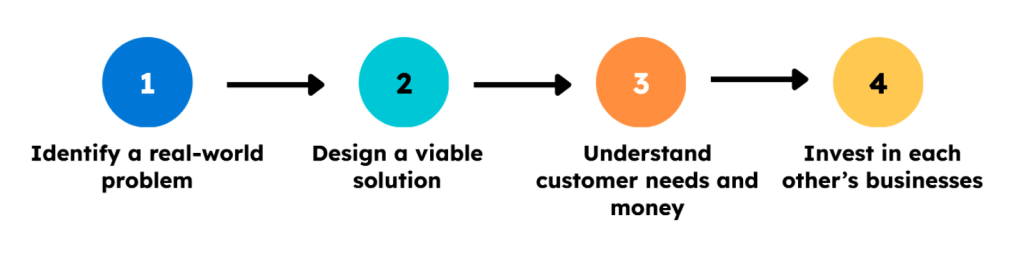
The Young Entrepreneur Programme is a practical, structured enterprise sprint in which your learners work in teams to:
- Identify a real-world problem
- Generate and refine a business idea
- Explore customer needs and value
- Consider pricing, cost and viability
- Develop teamwork, leadership, and communication skills
- Pitch their idea to an “investor” panel
The programme is delivered through discussion, challenge, collaboration and applied problem-solving, rather than slide-led teaching. It culminates in a Dragon’s Den-style showcase, where learners pitch their ideas to a panel of “investors.”
Each programme is fully facilitated by a GenNext Academy coach, requiring minimal preparation from school or college staff, whilst clearly aligning with curriculum, careers, and personal development priorities.
Your learners build confidence, gain leadership skills, and practice communication skills.
What the programme is not
The Young Entrepreneur Programme is not:
- A replacement for Business Studies or any other curriculum subject
- A one-off enrichment activity with no academic value
- A standalone careers guidance service
It is a high-quality enterprise and employability experience that strengthens curriculum learning, personal development and future readiness.
“Not everyone wants to be an entrepreneur, but entrepreneurial competencies […] help boost employability. Entrepreneurial competencies are transferable skills that help people succeed in diverse careers. They equip people to be proactive and to successfully navigate uncertainty and overcome resource constraints…”
Kings College London, 2021
How it works
We offer flexible delivery to suit your timetable and setting. All programmes are delivered by fully DBS-checked coaches in your school or college. We provide the structure, resources and facilitation; you just bring the eager young people.

Option 1: Intensive sprint
- Two full days delivered over two weeks
- Each group can include up to 30 learners

Option 2: Curriculum-friendly
- Two hours per week for 6 weeks (half term)
- Each group can include up to 30 learners
What learners actually do
Learners are active participants throughout the programme. They do not sit passively listening, they create, test, discuss, refine and present.

Take part in leadership and collaboration challenges

Work in teams with defined but flexible roles

Build simple business and pricing models

Practice pitching, body language and confident speaking

Interview potential customers and test assumptions

Respond to questions under pressure from an investor panel
This approach matters because research consistently shows that Learners are more likely to engage when learning feels relevant, purposeful, and connected to real life. Practical challenges give them the chance to see the value of their ideas, develop confidence, and experience success in a context that mirrors the world beyond education.
Outcomes for learners
By the end of the programme, learners will have:
- Increased self-confidence
- Stronger communication and teamwork skills
- Greater ability to explain an idea clearly and confidently
- Improved problem-solving and creativity
- A more positive approach to challenge and feedback
- Greater awareness of their strengths, interests and leadership potential
- Increased confidence in exploring a range of future pathways
This is especially important for learners who may not always thrive in purely academic settings, or who may be at greater risk of disengagement. Practical project-based learning can help them experience success, build momentum and see a clearer connection between school and future opportunity.
For senior leaders and careers teams, this creates a meaningful bridge between personal development, employability and progression.
Benefits for schools and colleges
For settings looking to strengthen their offer for learners who need additional motivation, relevance or aspiration, the programme provides a high-value intervention that sits comfortably alongside wider school improvement priorities.
Participating schools and colleges can expect:
- Improved learner engagement
- A practical contribution to careers education and personal development
- Stronger evidence of curriculum relevance
- Increased confidence among learners
- An inclusive offer that supports a broad range of learners
- A ready-made enterprise experience with minimal staff workload
- Clear opportunity for Gatsby Benchmark and Ofsted-aligned provision
The programme is designed to be inclusive, accessible and ambitious for all learners.
It is particularly well-suited to:
- high-attaining learners – open-ended challenge provides stretch without ceiling
- neuro-divergent learners – clear structure, practical tasks and role choice, support participation
- pupil-premium learners – the programme builds confidence and opens access to high-value enrichment
- learners who are unsure about traditional academic routes – helps them see the benefit of vocational, entrepreneurial and hands-on pathways
If your school or college is increasingly focused on disengagement and improving progression, this kind of practical experience can make a significant difference to how learners see themselves and their future.
The programme supports curriculum intent by helping learners develop communication, problem-solving and confidence through authentic real-world application.
It supports learning across KS3, KS4 and KS5, including:
- English – spoken language, persuasion and presentation
- Maths – financial reasoning, pricing and simple budgeting
- PSHE and Citizenship – confidence, collaboration, decision-making and teamwork
- Design & Technology – innovation, problem-solving and iteration
It also gives teachers a practical way to connect subject learning to future pathways, helping learners understand that the skills they develop in lessons are transferable, relevant and valued beyond the classroom.
The Young Entrepreneur Programme can go towards supporting several Gatsby Benchmarks, particularly:
- Benchmark 1 – A stable careers programme
- Benchmark 2 – Learning from career and labour market information
- Benchmark 3 – Addressing the needs of each learner
- Benchmark 4 – Linking curriculum learning to careers
- Benchmark 5 – Encounters with employers and employees
- Benchmark 6 – Experiences of workplaces
- Benchmark 8 – Personal guidance
IT provides strong evidence of meaningful careers and enterprise provision, and can support wider conversations around curriculum intent, personal development and future readiness.
For careers leaders, it offers a clear and flexible way to strengthen provision in an engaging, scalable, and easy-to-evidence format.
For post-16 settings, the programme supports:
- Employability
- Work-readiness
- Communication and confidence
- Teamwork and leadership
- Problem-solving
- Career awareness
- Industry-style thinking
- Preparation for apprenticeships, employment, FE and HE progression
At this stage, young people need opportunities that help them build identity, direction and readiness for the next step. Enterprise learning provides a useful space for learners to practice those skills in a setting that feels purposeful and authentic.
The programme can contribute positively to evidence areas such as:
- Personal development
- Curriculum relevance
- Careers education
- Personal, social and employability skills
- Enrichment and cultural capital
For senior leaders, it can also support the articulation of how your school or college provides experiences that broaden aspiration, strengthen resilience and prepare learners for life beyond education.
Research and Evidence
Research from the UK and internationally suggests that entrepreneurship and project-based learning can:
- improve confidence and self-efficacy
- strengthen creativity and collaboration
- develop communication and problem-solving skills
- improve career readiness and aspiration
- help young people engage with learning more positively
This is particularly relevant at a time when schools and colleges are being asked to do more to support engagement, progression and future readiness. Where learning feels practical, purposeful and connected to the real world, learners are more likely to see its value and participate with confidence.
Entrepreneurial learning is especially valuable because it helps learners understand how knowledge, skills and attitudes transfer into real-world settings. That has clear relevance for learners who may be vulnerable to disengagement, as well as those who are ready for stretch and challenge.